
For Christmas last year, I gifted my husband Dr. Alexandra Solomon’s book, “Love Every Day.” (Sidenote, this was also, unabashedly, a gift for me.)
We’re doing our best to keep up with the daily reflections and we’re each keeping a journal with our comments, questions, and favorite quotes as we go along. Today I was catching up on a few entries from late January (like I said, we’re doing our best!) and the one for the 27th resonated with a conversation I had in a coaching session with a couple recently. Let’s explore the theme together.
A hallmark of couples in conflict is the presence of a binary stance — black/white thinking as opposed to shades of grey. By comparison, a hallmark of relational self-awareness (Dr. Solomon’s term for the ongoing curious and compassionate relationship we each have with ourselves) is a shift into a relational stance — a sense of “we’re in this together” as opposed to “it’s me against you.” In shorthand:
Binary stance: Me versus You
Relational stance: Me + You versus The Problem
I asked Chat GPT to create an image to help visualize these concepts:
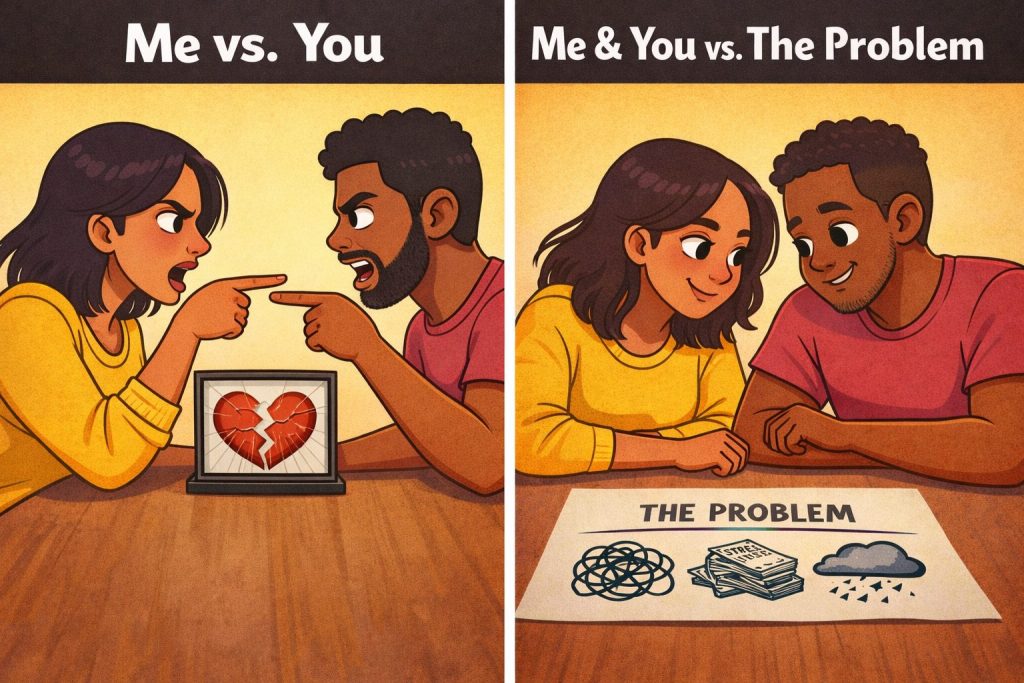
In Dr. Solomon’s words, “When you and your partner look together at the problem, you will start to see new paths from disconnection to connection and new possibilities for how you can help each other balance acceptance and change.“
Here’s how these concepts played out in that recent couple coaching session I mentioned: Partner A and Partner B are getting married this summer and they have been arguing lately about combining their finances. Partner A is more of a saver and is worried that Partner B spends too much on discretionary purchases. Partner B feels accused of being irresponsible with money despite carrying zero debt.
Initially, they were framing the problem “inside” their partner — Partner A said, “I feel like I have to be the adult and be the responsible one for both of us. It’s like you don’t care about our future.” Partner B shot back defensively, “You care more about our non-existent-kids’ college funds than our honeymoon! Why don’t you want to have a great time with me?”
Yikes! The problem is centered in the other person’s character and the emotional tone is full of judgement, defensiveness, and posturing. With some gentle questions, and a reframing the problem to sit “outside” each other, we shifted the conversation.
We started with the new framing, “Our system around money isn’t working for either of us.” We identified the dynamics at play (balancing needs for security and freedom), the family histories at play (balancing experiences of scarcity and abundance), and the shared values at play (the purpose of money is to facilitate a shared lifestyle). The conversation naturally moved away from gridlock and accusations towards problem solving and compromise. We discussed what is the blend of spending and saving that achieves both partners’ goals — the long-term savings account for college funds and the short-term savings account for the honeymoon? And the tone shifted into curiosity, empathy, and a sense of teamwork. They left the session holding hands, connected.
The next time you’re in conflict with your partner, take a moment to notice whether your stance is more binary than relational. Then intentionally shift your perspective from “me versus you” to “me and you verses the problem.”
Coaching and couple therapy can be helpful to teach the skills of relational self-awareness that Dr. Solomon writes about. Interested in learning more? Contact a relationship coach or personal development coach at Capital Crescent Collective! We’re available to work with clients in person in Bethesda, MD or virtually worldwide.

This post was written by Dr. Emily Racic, a relationship coach with over 15 years of experience helping couple repair and enrich. She’s also the owner of Capital Crescent Collective.